01
Use more solar on site
Store available solar energy and dispatch it later when facility demand is higher or solar production has reduced.

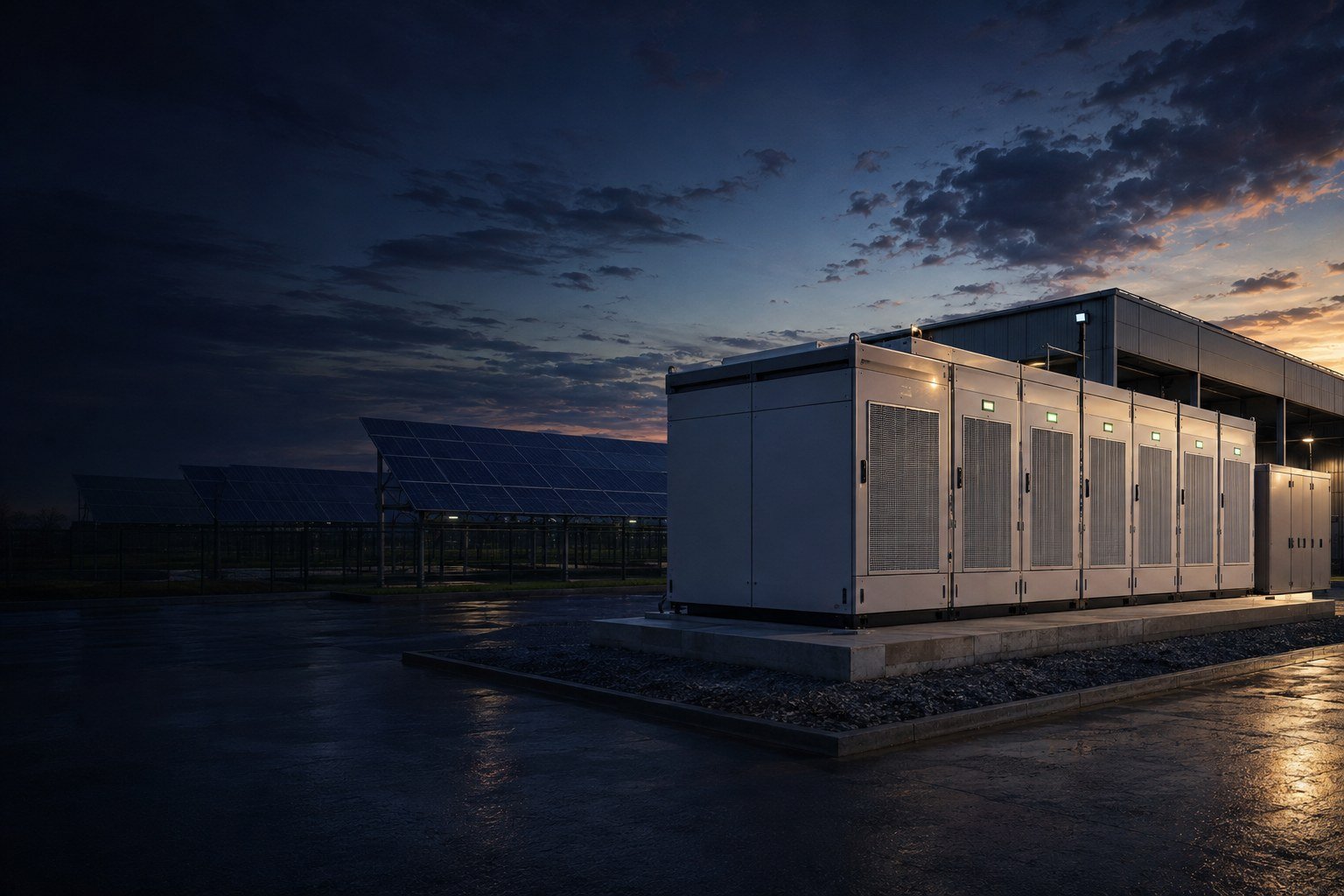
Store energy with purpose
Plan and integrate battery energy storage around solar generation, demand patterns, critical loads, site conditions and operating priorities.
Designed around your priorities
The same battery can serve different objectives. Its controls and system architecture should follow the result your site actually needs.
Store available solar energy and dispatch it later when facility demand is higher or solar production has reduced.
Use controlled battery discharge to address short-duration demand peaks where the site load profile and applicable tariff make that useful.
Design suitable transfer, protection and islanding controls so selected critical loads can be supplied during an outage when backup is part of the agreed scope.
Manage charging and discharging alongside solar, utility supply and compatible generators through an agreed energy-control strategy.
BESS engineering
A useful BESS begins with a clearly defined operating objective. We review available load information, solar generation, outage priorities, tariffs and the electrical context before shaping the power rating, usable energy, controls, protection and site-integration concept. The result is a project scope that connects storage with the way the facility actually operates.
How much instantaneous demand the system can charge or supply within its operating limits.
How much usable energy is available, which helps determine duration at a defined load.
Safety and project contextBattery storage is high-energy electrical equipment. Final design depends on battery chemistry, capacity, enclosure, installation location, equipment documentation, a site-specific risk assessment and the approvals applicable to the project.
Where BESS may fit
A defined engineering scope
Connected system architecture
Equipment selection is one part of a BESS. Useful operation depends on how its components communicate, protect the site and respond to the agreed dispatch strategy.
Final equipment, chemistry, configuration and approvals remain project-specific.
Battery modules store energy while the battery-management system supervises cell conditions, limits and protective responses.
A bidirectional inverter or power conversion system controls the electrical flow between the battery and the site.
Controls coordinate dispatch, operating reserves, alarms, metering and the agreed interaction with solar, grid and generator sources.
Switchgear, earthing, isolation, thermal management, emergency controls and fire-safety provisions are developed for the selected equipment and location.
Engineering process
Each stage reduces uncertainty before the next decision is made.
Review electricity data, solar production, outage history, critical loads, site constraints and the outcome the system should support.
Compare power, usable energy, duration, reserve, cycling, losses and degradation assumptions against practical dispatch scenarios.
Develop the electrical architecture, protection, controls, earthing, enclosure, thermal-management and safety strategy.
Coordinate installation and test protection, alarms, communications, emergency shutdown, monitoring and any agreed backup functions.
Review operating data, maintain safety systems, follow equipment guidance and plan future augmentation, replacement or decommissioning.
BESS questions
Depending on the design, a BESS can store available solar energy for later use, manage short-duration demand peaks, coordinate solar, grid and compatible generator sources, or support selected critical loads during an outage. The useful applications depend on the site load profile, tariff, electrical arrangement and operating objective.
Sizing considers both power in kW and usable stored energy in kWh. The assessment also reviews interval-load data where available, critical-load demand, required duration, solar production, operating reserve, discharge limits, losses, temperature, cycling, battery condition over time and the intended control strategy.
Not automatically. Backup operation must be included in the design, with the required usable energy, power rating, critical-load separation, transfer controls, protection and islanding capability. Battery storage is high-energy equipment, so the project must also address equipment limits, thermal management, emergency shutdown, fire safety, access and site-specific operating procedures.
Start with a site assessment
Share the site, load information you have, solar-system status and the outcome you want the BESS to support.