Preparation and isolation
The circuit is reviewed, de-energised and isolated as required. Sensitive connected equipment is identified before a test voltage is applied.

Check insulation condition
Insulation resistance testing checks suitable de-energised circuits or components for leakage paths that may indicate damaged, contaminated or deteriorated insulation.
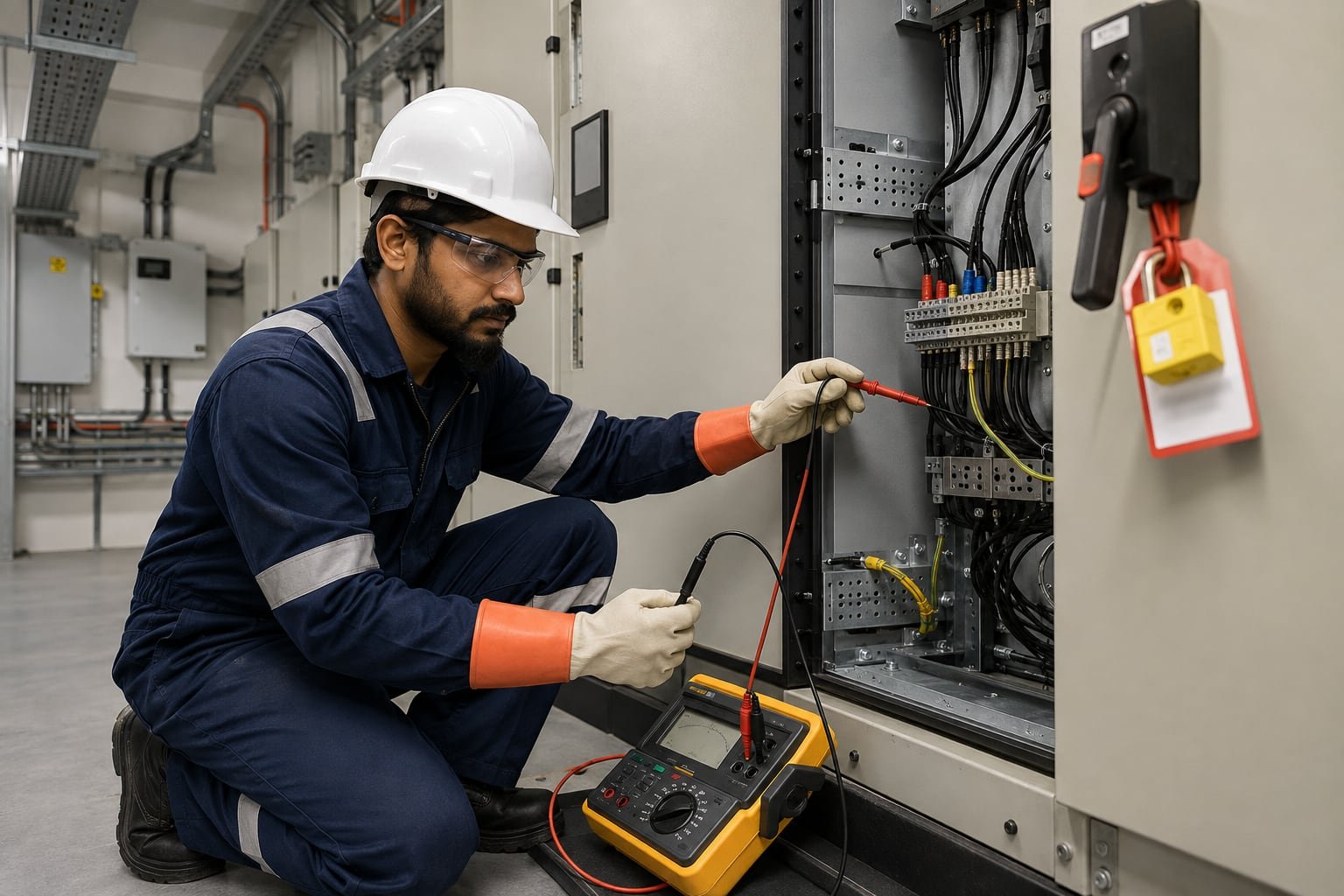
Insulation-resistance testing is performed on a suitable de-energised and isolated circuit using an appropriate test voltage.
Illustrative field-work imageOverview
The circuit and connected equipment must be reviewed before testing. Where the test is suitable, we isolate the agreed section, apply the appropriate test procedure and record readings with relevant conditions. Any anomalies are reported for further investigation or corrective action.
Important contextInsulation testing normally requires de-energisation and careful isolation of sensitive connected equipment before a test voltage is applied.
Inspection scope
The final method depends on access, system state, safety requirements and the objective agreed before testing.
Circuit and connected-equipment review
Isolation and test preparation
Insulation resistance measurement on agreed circuits
Reading and condition documentation
Findings and recommended next actions
How to interpret the service
The circuit is reviewed, de-energised and isolated as required. Sensitive connected equipment is identified before a test voltage is applied.
A suitable insulation-resistance tester is selected for the circuit and testing objective, with instrument condition and leads checked before use.
The test voltage follows the equipment, circuit and relevant technical guidance. A higher voltage is never selected without confirming suitability.
Measurements are recorded across the agreed conductors and earth, then interpreted with circuit length, connected equipment, environment and prior results.
Before the site visit
It measures resistance through the insulation of a suitable isolated circuit or component. A low or unusual reading may indicate moisture, contamination, damage or deterioration that needs further investigation. Sensitive connected equipment must be reviewed and isolated as required before testing.
Some observations can be completed while equipment is operating, while other tests require controlled isolation or de-energisation. We identify access, safety and shutdown needs during scoping so the site can plan the work appropriately.
The agreed output can include the scope, relevant site conditions, observations, recorded measurements, supporting images where applicable, limitations and recommended next actions. The exact report format is confirmed before the visit.
Start with a site assessment
Share the system type, site location and condition you need to investigate. We will use that context to shape the next conversation.